0/90 and off-axis layers
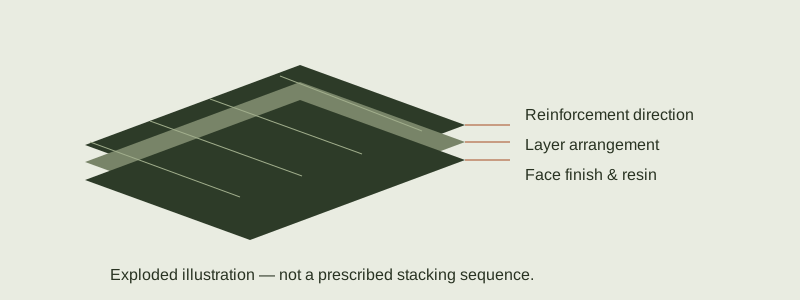
A laminate’s in-plane response depends on its reinforcement directions. A 0/90 construction and a quasi-isotropic layup are not interchangeable simply because thickness matches.
FACTORY-DIRECT / CUSTOM MANUFACTURING
Specify thickness, size and laminate. Choose the faces you need, then add cut outlines, holes and CNC machining to your enquiry.
Custom dimensions · Cutting & drilling · Quoted to your drawing
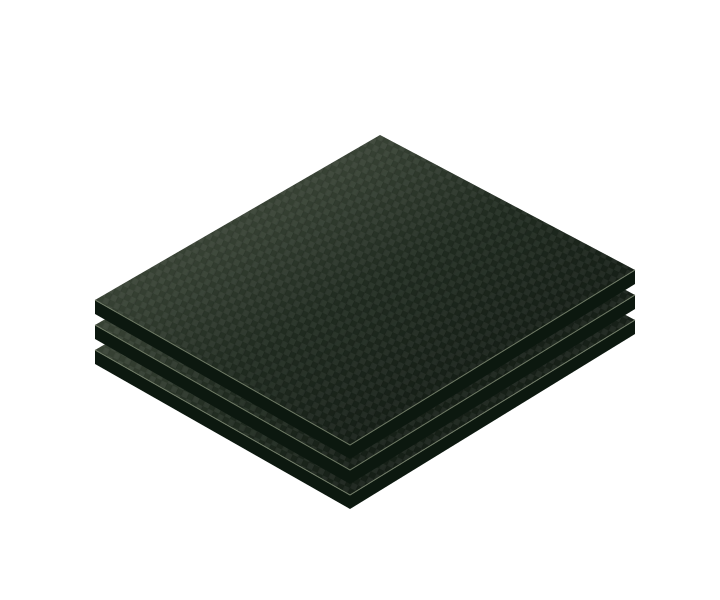
Length × width × thickness.
Add layup, visible faces, tolerances and finished outline.
Drawing example, not a stock item.
MAKE YOUR REQUIREMENTS CLEAR
Enter the required blank or overall part envelope. For shaped parts, attach the finished outline to your enquiry email. Surface appearance and thickness do not define the complete laminate.
These values start a custom enquiry. Dimensions, tolerances, material and production feasibility are confirmed in the quotation.
Ask for material, tooling where needed, machining, samples and delivery costs to be identified separately. Add the delivery country and target quantity for a useful comparison.
Reference formats for custom enquiries, not a stock list. Thin sheet, solid laminate and sandwich panel are different specifications. Thickness and sheet size combinations, laminate, flatness and tolerances are confirmed before production.
Dimensions in millimetres unless shown otherwise. Scroll sideways on a small screen.
| Reference construction | Nominal thickness examples | Blank format examples |
|---|---|---|
| Rigid sheet, one glossy face | 1 / 2 / 3 / 4 mm | 250 × 230; 500 × 470; 1000 × 980; 2000 × 980 mm |
| Double-sided sheet range | 0.25 / 0.5 / 1 / 1.5 / 2 / 3 mm | 285 × 140; 285 × 285; 580 × 285; 580 × 580 mm |
| Custom cut or machined part | To the agreed laminate and drawing | Finished outline, holes and datums to drawing |
| Custom pressed laminate | 1 / 2 / 3 / 5 mm as enquiry examples | 1200 × 1000 mm reference format; confirm tooling and usable area |

A laminate’s in-plane response depends on its reinforcement directions. A 0/90 construction and a quasi-isotropic layup are not interchangeable simply because thickness matches.
Specify which faces are visible and which are bonded. A glossy cosmetic face and a textured bonding face serve different needs.
A thin decorative facing is not a substitute for a structural plate. A sandwich panel adds a core, with different edge, insert and fastening requirements.
Provide the finished outline, thickness, hole and slot positions, and dimensional references. Distinguish overall blank tolerance from machined-feature tolerance.
Cutting and drilling can expose fraying or separation between layers. Discuss edge finishing and inspection; cosmetic cleanup does not automatically restore a damaged laminate.
Tell us where the sheet bonds or bolts to another part. Local loads, surface preparation and contact with dissimilar materials need an application-specific review.
Attach a dimensioned PDF and, if available, a DXF or STEP file to your enquiry email. State the units, drawing revision and quantity of each part.
Identify the visible face, weave orientation and load direction. Mark bonding faces and any areas where a cosmetic finish matters.
Mark critical hole sizes, slots, countersinks and thickness tolerances. Confirm fibre orientation before arranging parts on the sheet to reduce waste.
Not generally. Geometry affects bending stiffness strongly, while layup, span, support and loading also matter. Do not use thickness alone to assign a load capacity.
Not without knowing its laminate. Quasi-isotropic refers to an approximation of in-plane behaviour, not equal properties in every three-dimensional direction.
Yes, send the outline or drawing, quantity, thickness and required finish. We will agree the machining scope and acceptance requirements in the quotation.
You don’t need a complete specification to start a conversation. Tell us the application and what you know so far.
sales@fibreparts.com ↗