Choose the laminate before the weave
A 3K woven surface does not tell you the internal layup. Load direction, torsion and fastener locations should inform the laminate specification. Record the agreed construction for repeat batches.
CUSTOM MANUFACTURING / PRACTICAL SPECIFICATION
CNC-cut frame plates, mounting plates and prepared tube arms made to your drawings. Bring the laminate, machining and mating interfaces into one clear quotation.
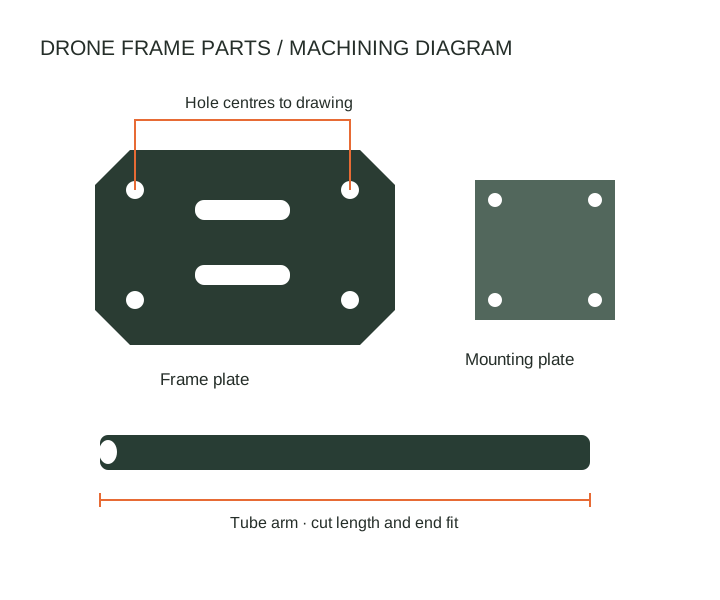
The values below are starting points for a custom enquiry. Final sizes, tolerances, material, accessories and acceptance checks are agreed before production.
| Parameter | What to specify |
|---|---|
| Plate thickness | 2, 3, 4 and 5 mm are example nominal thicknesses for an initial enquiry, not a load recommendation or stock promise. State the finished thickness and tolerance; other requests are reviewed. |
| Plate outline | Supply a dimensioned DXF plus PDF with units, revision, quantity and critical dimensions. Define overall envelope, internal radii, slots and edge treatment. |
| Tube arms | Specify OD × ID × cut length in mm, layup requirement, end finish, clamp zones and hole positions. Match both the motor mount and centre-frame connection. |
| Mounting pattern | Provide hole diameters, centre distances and datum references. Do not rely on a generic flight-controller or motor-mount pattern. |
| Material construction | State solid carbon laminate or a specified alternative. Surface weave is a finish description; internal fibre orientation and resin requirements must also be agreed. |
| Machining features | Through-holes, slots, trimmed profiles and suitable pockets can be reviewed. Countersinks, small internal corners and remaining wall thickness need design review. |
| Weight & validation | Finished mass depends on the geometry and laminate. A target mass can be quoted against a drawing; structural suitability and flight validation belong to the complete design. |
| Supply scope | Individual plates, prepared arms or agreed sets of machined parts. Motors, batteries, controllers, wiring and flight certification are not included. |
A 3K woven surface does not tell you the internal layup. Load direction, torsion and fastener locations should inform the laminate specification. Record the agreed construction for repeat batches.
Holes close to an edge and deeply countersunk thin plates can leave little load-bearing material. Review edge distance, remaining thickness, washer contact and local crushing with the designer.
Define clamp contact length, mounting offset and the positions of drilled features. Holes interrupt fibres; specify whether the connection uses clamps, inserts or locally reinforced regions.
Select critical hole positions, plate flatness, tube fit, edge condition and part mass for sample inspection. Avoid a blanket tolerance when only a few assembly dimensions are critical.
Tell us the application, sample quantity, expected batch quantity and delivery postcode. We can separate material, machining, fittings, tooling, inspection and shipping in the quotation. Lead time and minimum order are confirmed after design review.
Dimensions can be discussed before a drawing is complete. For files, email sales@fibreparts.com with the drawing revision and units.
A photo is useful context but does not define hole positions, laminate or tolerances. Supply a drawing you are authorised to use, or discuss a measured sample and a new drawing for approval.
No. This page covers custom structural parts. Flight system integration and validation are outside the standard parts quotation.
No certification or approved-airframe compatibility is implied. Send any material traceability, test or documentation requirements before quotation so feasibility and scope can be reviewed.
Material construction, thickness, nesting yield, machining features, quantities, inspection and packing. Request separate sample, tooling and production costs for a useful comparison.
You don’t need a complete specification to start a conversation. Tell us the application and what you know so far.
sales@fibreparts.com ↗